

0 5 On A Graph
Learning Objectives
- (1.3.1) – Plotting points on a coordinate plane
- (1.3.2) – Create a table of ordered pairs from a 2-variable linear equation and graph
- (i.3.three) – Decide whether an ordered pair is a solution of an equation
- (1.3.4) – Recognizing and using intercepts
-
Using intercepts to graph lines
-
- (1.iii.5) – Graphing other equations using a table or ordered pairs
(1.3.1) – Plotting points on a coordinate plane
The coordinate plane was developed centuries agone and refined by the French mathematician René Descartes. In his honor, the system is sometimes called the Cartesian coordinate arrangement. The coordinate plane can be used to plot points and graph lines. This system allows us to describe algebraic relationships in a visual sense, and also helps u.s. create and interpret algebraic concepts.
You take probable used a coordinate aeroplane before. The coordinate plane consists of a horizontal axis and a vertical axis, number lines that intersect at right angles. (They are perpendicular to each other.)
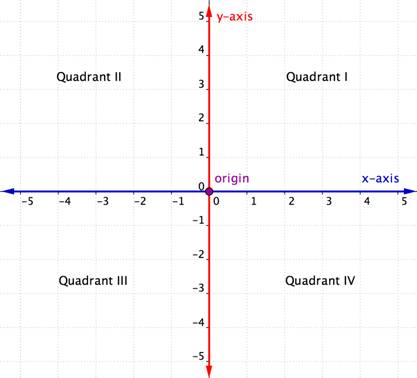
The horizontal axis in the coordinate aeroplane is called the x-axis. The vertical axis is called the y-centrality. The signal at which the two axes intersect is chosen the origin. The origin is at 0 on the x-centrality and 0 on the y-axis.
Locations on the coordinate airplane are described every bit ordered pairs. An ordered pair tells you the location of a point by relating the point's location along the x-axis (the start value of the ordered pair) and along the y-centrality (the second value of the ordered pair).
In an ordered pair, such equally (x, y), the first value is called the 10-coordinate and the second value is the y-coordinate. Notation that the x-coordinate is listed before the y-coordinate. Since the origin has an x-coordinate of 0 and a y-coordinate of 0, its ordered pair is written (0, 0).
Consider the point beneath.
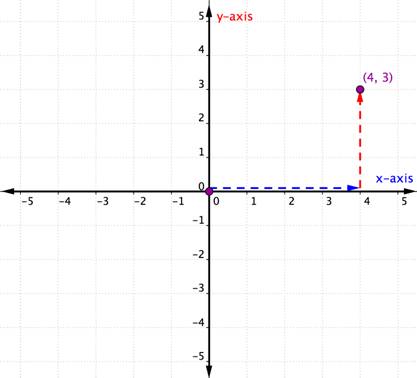
To identify the location of this indicate, showtime at the origin (0, 0) and move correct forth the ten-axis until yous are under the point. Look at the label on the x-axis. The 4 indicates that, from the origin, you take traveled iv units to the right forth the x-axis. This is the x-coordinate, the first number in the ordered pair.
From iv on the 10-axis motion up to the point and notice the number with which it aligns on the y-axis. The 3 indicates that, afterwards leaving the x-axis, you traveled 3 units up in the vertical direction, the direction of the y-axis. This number is the y-coordinate, the 2nd number in the ordered pair. With an 10-coordinate of iv and a y-coordinate of iii, you have the ordered pair (4, three).
Example
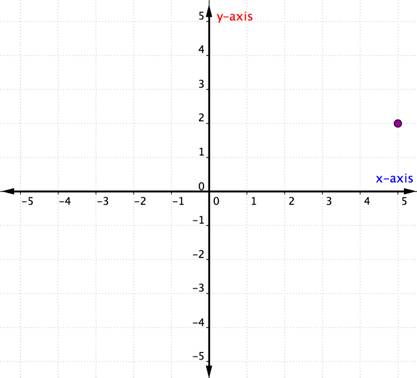
Describe the signal shown equally an ordered pair.
Example
Plot the point [latex](−4,−2)[/latex].
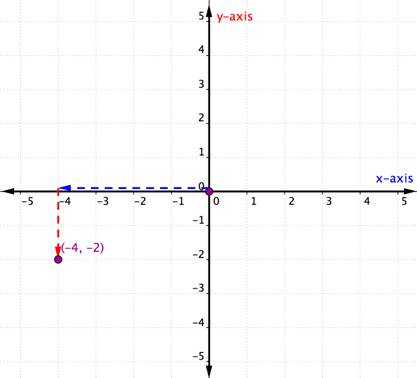
The x-coordinate is [latex]−4[/latex] because it comes offset in the ordered pair. Kickoff at the origin and motion 4 units in a negative direction (left) along the x-axis.
The y-coordinate is [latex]−two[/latex] because it comes second in the ordered pair. Now move 2 units in a negative direction (downwards). If yous expect over to the y-axis, you lot should be lined up with [latex]−ii[/latex] on that axis.
Bear witness Answer
Draw a point at this location and label the point [latex](−4,−two)[/latex].
Graphing ordered pairs is only the beginning of the story. Once y'all know how to identify points on a filigree, you tin use them to brand sense of all kinds of mathematical relationships.
You tin can utilize a coordinate plane to plot points and to map various relationships, such as the relationship between an object's distance and the elapsed time. Many mathematical relationships are linear relationships . Let's look at what a linear relationship is.
(i.3.ii) – Create a table of ordered pairs from a ii-variable linear equation and graph
A linear relationship is a relationship between variables such that when plotted on a coordinate plane, the points lie on a line. Permit'south start by looking at a series of points in Quadrant I on the coordinate plane.
These series of points can also be represented in a table. In the table beneath, the 10- and y-coordinates of each ordered pair on the graph is recorded.
| x -coordinate | y -coordinate |
| 0 | 0 |
| 1 | two |
| 2 | 4 |
| 3 | 6 |
| iv | eight |
Notice that each y-coordinate is twice the corresponding x-value. All of these x- and y-values follow the same pattern, and, when placed on a coordinate airplane, they all line upwards.
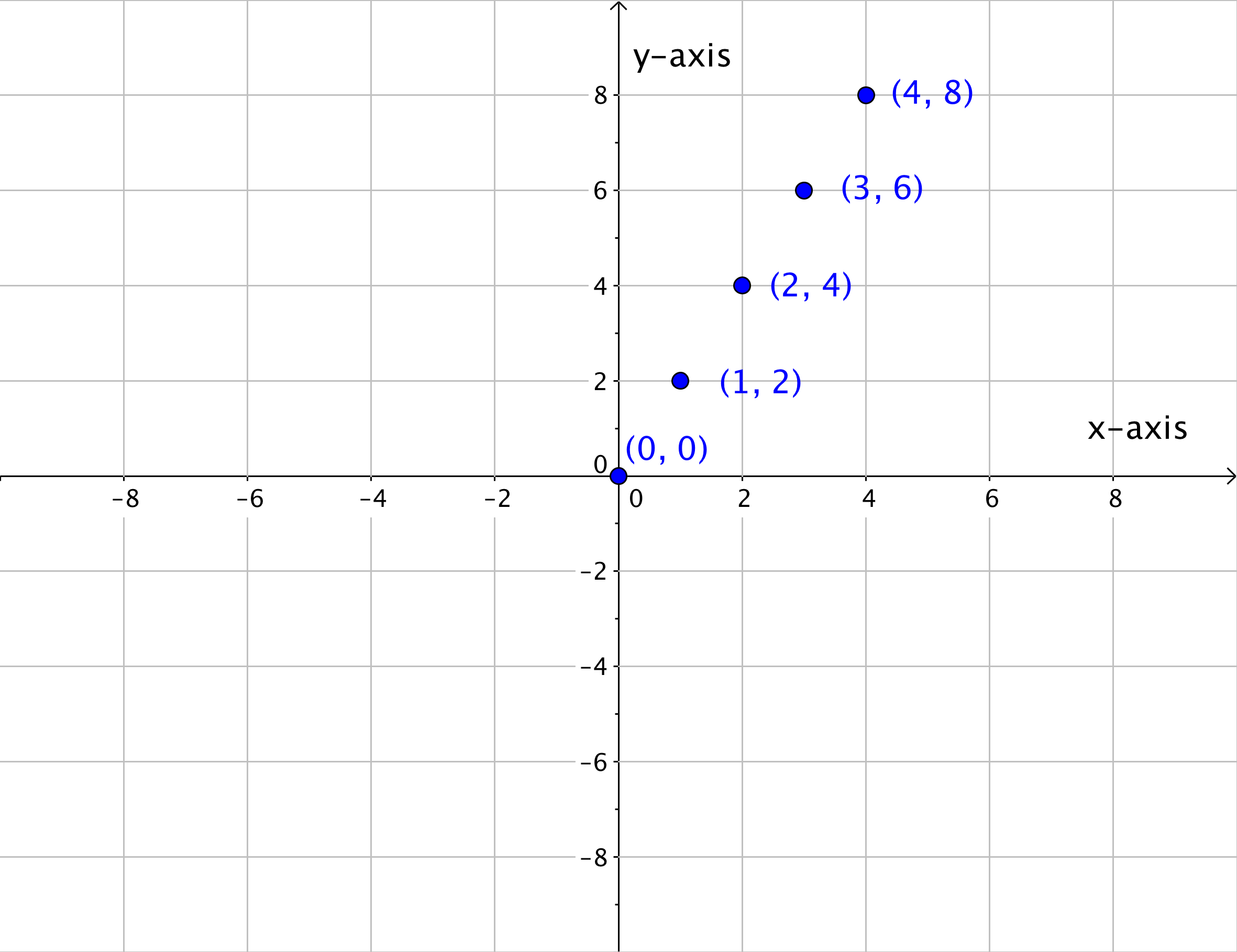
Once you know the pattern that relates the x- and y-values, you can find a y-value for any ten-value that lies on the line. So if the rule of this pattern is that each y-coordinate is twice the corresponding ten-value, then the ordered pairs (1.v, 3), (2.5, five), and (3.5, 7) should all appear on the line too, correct? Look to see what happens.
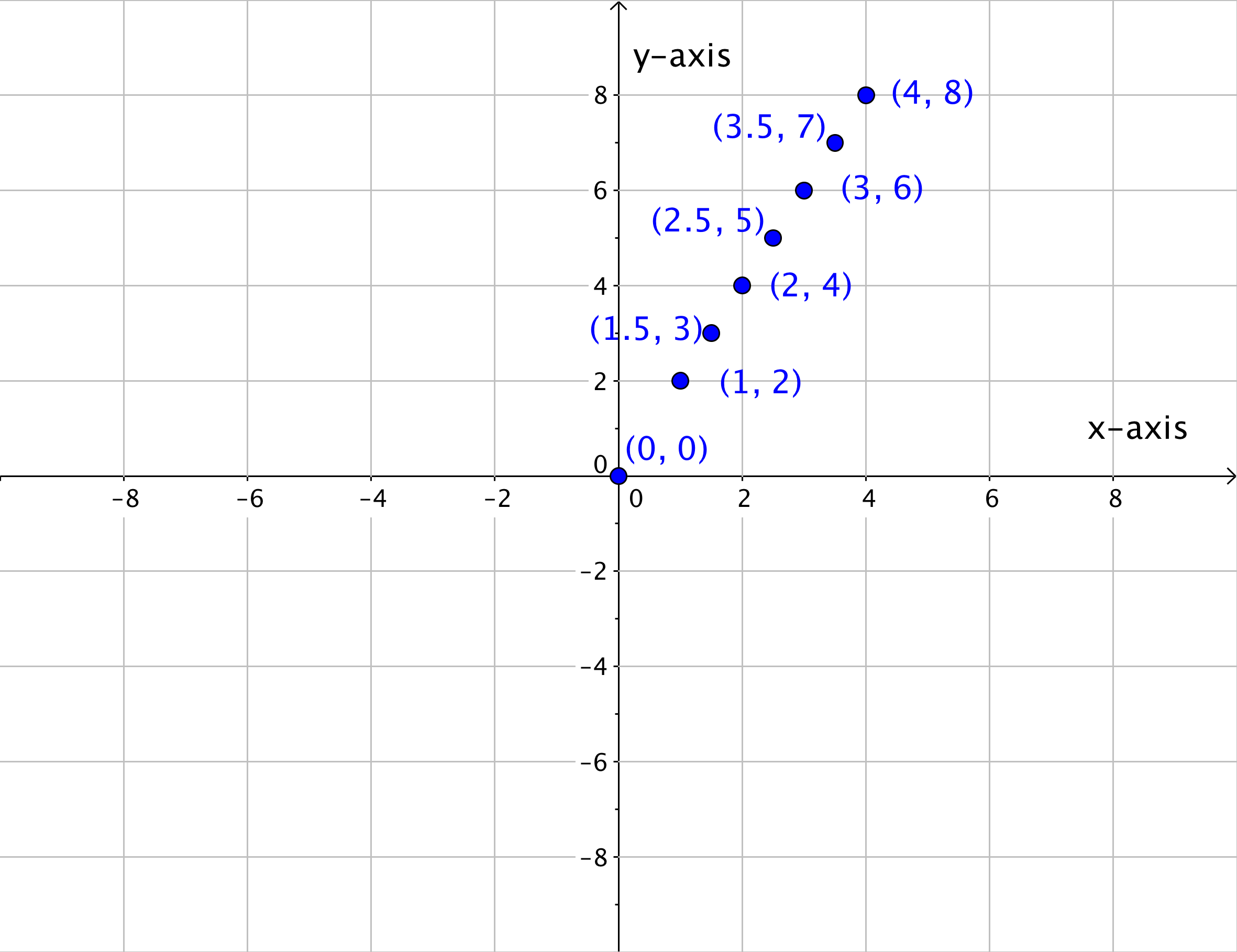
If you were to go along adding ordered pairs (10, y) where the y-value was twice the x-value, yous would end up with a graph like this.
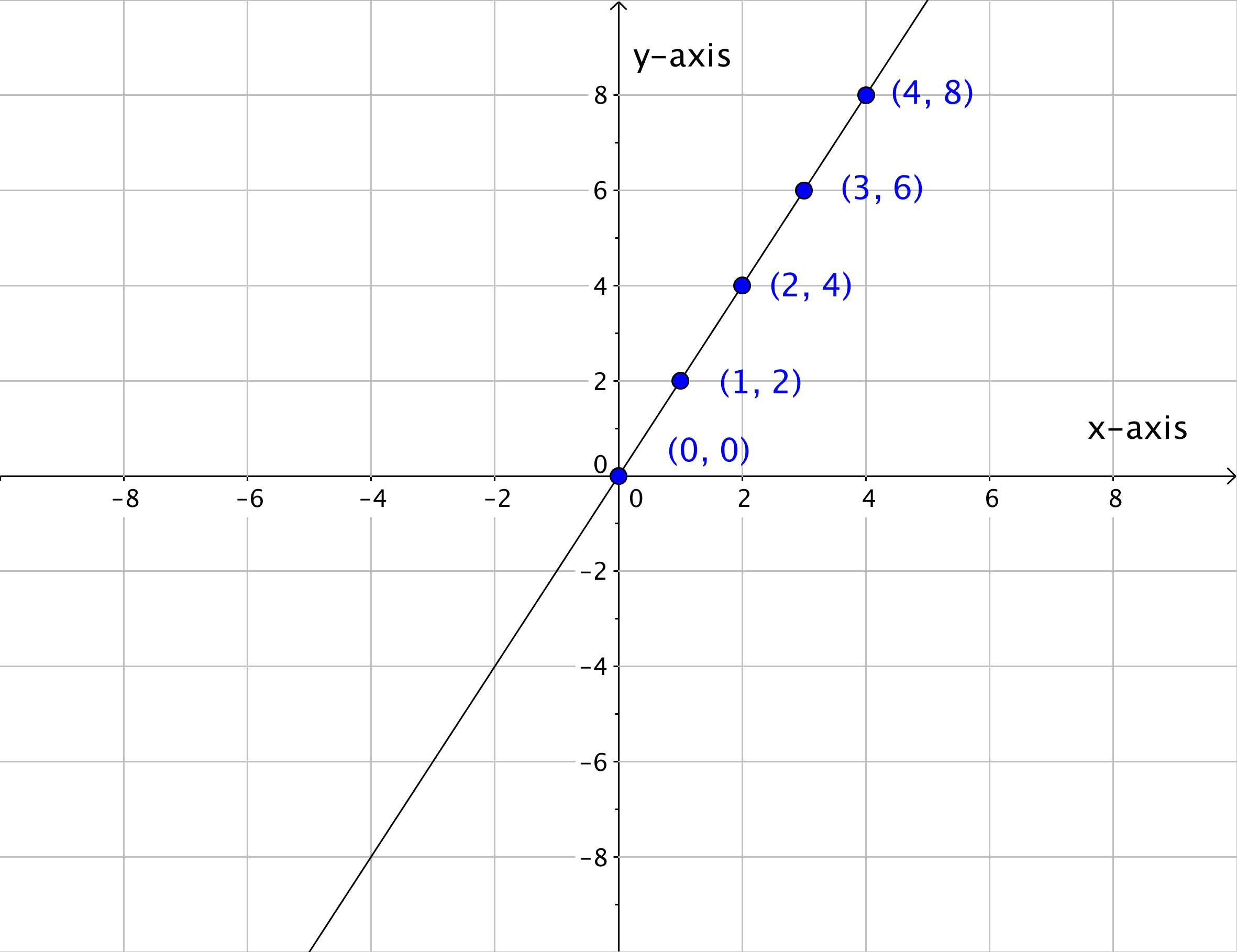
Look at how all of the points blend together to create a line. You can call back of a line, and then, as a collection of an infinite number of individual points that share the same mathematical relationship. In this case, the relationship is that the y-value is twice the ten-value.
In that location are multiple means to represent a linear human relationship—a tabular array, a linear graph, and there is also a linear equation . A linear equation is an equation with two variables whose ordered pairs graph as a direct line.
At that place are several ways to create a graph from a linear equation. One style is to create a tabular array of values for 10 and y, so plot these ordered pairs on the coordinate plane. Two points are enough to decide a line. However, it's always a expert thought to plot more than 2 points to avoid possible errors.
Then you draw a line through the points to show all of the points that are on the line. The arrows at each finish of the graph indicate that the line continues endlessly in both directions. Every indicate on this line is a solution to the linear equation.
Example
Graph the linear equation [latex]y=2x+3[/latex].
(1.iii.iii) – Make up one's mind whether an ordered pair is a solution of an equation
So far, y'all have considered the following ideas about lines: a line is a visual representation of a linear equation, and the line itself is made up of an infinite number of points (or ordered pairs). The picture below shows the line of the linear equation [latex]y=2x–5[/latex] with some of the specific points on the line.
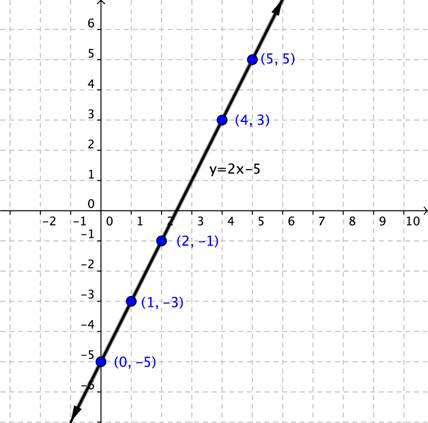
Every bespeak on the line is a solution to the equation [latex]y=2x–five[/latex]. You tin attempt any of the points that are labeled similar the ordered pair, [latex](1,−3)[/latex].
[latex]\begin{array}{50}\,\,\,\,y=2x-5\\-3=2\left(1\right)-5\\-3=2-5\\-3=-3\\\text{This is truthful.}\cease{array}[/latex]
You can too try Whatever of the other points on the line. Every signal on the line is a solution to the equation [latex]y=2x–5[/latex]. All this ways is that determining whether an ordered pair is a solution of an equation is pretty straightforward. If the ordered pair is on the line created by the linear equation, then it is a solution to the equation. But if the ordered pair is not on the line—no matter how close it may await—so it is not a solution to the equation.
Identifying Solutions
To find out whether an ordered pair is a solution of a linear equation, yous can practise the following:
- Graph the linear equation, and graph the ordered pair. If the ordered pair appears to be on the graph of a line, then it is a possible solution of the linear equation. If the ordered pair does not lie on the graph of a line, so information technology is non a solution.
- Substitute the (x, y) values into the equation. If the equation yields a truthful statement, then the ordered pair is a solution of the linear equation. If the ordered pair does not yield a true statement then it is not a solution.
Example
Decide whether [latex](−two,4)[/latex] is a solution to the equation [latex]4y+5x=3[/latex].
(1.3.4) – Recognizing and using intercepts
The intercepts of a line are the points where the line intercepts, or crosses, the horizontal and vertical axes. To assistance y'all remember what "intercept" means, call up about the word "intersect." The two words sound akin and in this case mean the same matter.
The straight line on the graph beneath intercepts the two coordinate axes. The point where the line crosses the ten-centrality is called the x-intercept. The y-intercept is the bespeak where the line crosses the y-axis.
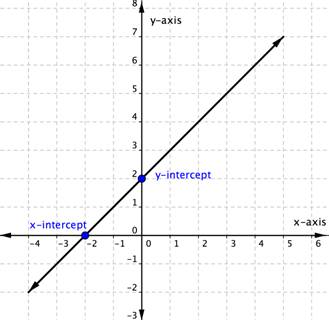
The x-intercept to a higher place is the point [latex](−2,0)[/latex]. The y-intercept above is the point (0, 2).
Notice that the y-intercept ever occurs where [latex]x=0[/latex], and the x-intercept ever occurs where [latex]y=0[/latex].
To find the x– and y-intercepts of a linear equation, you can substitute 0 for y and for ten respectively.
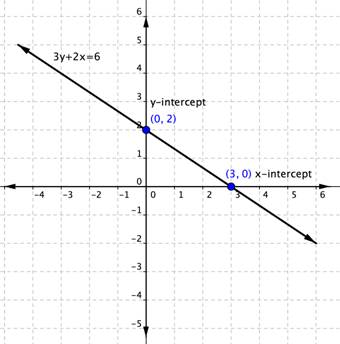
For instance, the linear equation [latex]3y+2x=six[/latex] has an 10 intercept when [latex]y=0[/latex], so [latex]3\left(0\right)+2x=6\\[/latex].
[latex]\begin{array}{r}2x=6\\x=iii\end{array}[/latex]
The x-intercept is [latex](3,0)[/latex].
Likewise the y-intercept occurs when [latex]ten=0[/latex].
[latex]\begin{array}{r}3y+ii\left(0\correct)=6\\3y=6\\y=ii\end{array}[/latex]
The y-intercept is [latex](0,2)[/latex].
Using Intercepts to Graph Lines
You can use intercepts to graph linear equations. In one case you accept found the 2 intercepts, draw a line through them.
Let'southward practice it with the equation [latex]3y+2x=6[/latex]. You figured out that the intercepts of the line this equation represents are [latex](0,2)[/latex] and [latex](3,0)[/latex]. That's all you need to know.
Example
Graph [latex]5y+3x=30[/latex] using the x and y-intercepts.
Example
Graph [latex]y=2x-4[/latex] using the 10 and y-intercepts.
(one.3.5) – Graphing other equations using a table or ordered pairs
Example
Graph the equation [latex]y=|x+2|-1[/latex].
Try It

0 5 On A Graph,
Source: https://courses.lumenlearning.com/cuny-hunter-collegealgebra/chapter/outcome-the-coordinate-plane-2/
Posted by: todaroyouthe.blogspot.com
0 Response to "0 5 On A Graph"
Post a Comment